By Cam, Product Manager at clixifix®
The housing sector isn’t short of AI hype. Every proptech pitch deck promises to “revolutionise” something. But when your team is managing hundreds of open defects across multiple sites, the last thing you need is technology that adds complexity without earning its place.
At clixifix, we’re taking a different approach. Rather than bolting on AI features for the sake of a press release, we’re asking a simpler question: where are teams actually losing time, and can a small, focused tool win it back?
The answer, it turns out, is yes, and the impact can be bigger than you might expect.
The Summary That Saves Hours
Anyone who works in aftercare knows how a single defect can accumulate dozens of comments over several weeks or months. Site updates, resident queries, subcontractor responses and internal notes all build into a thread that nobody has time to reread from the beginning.
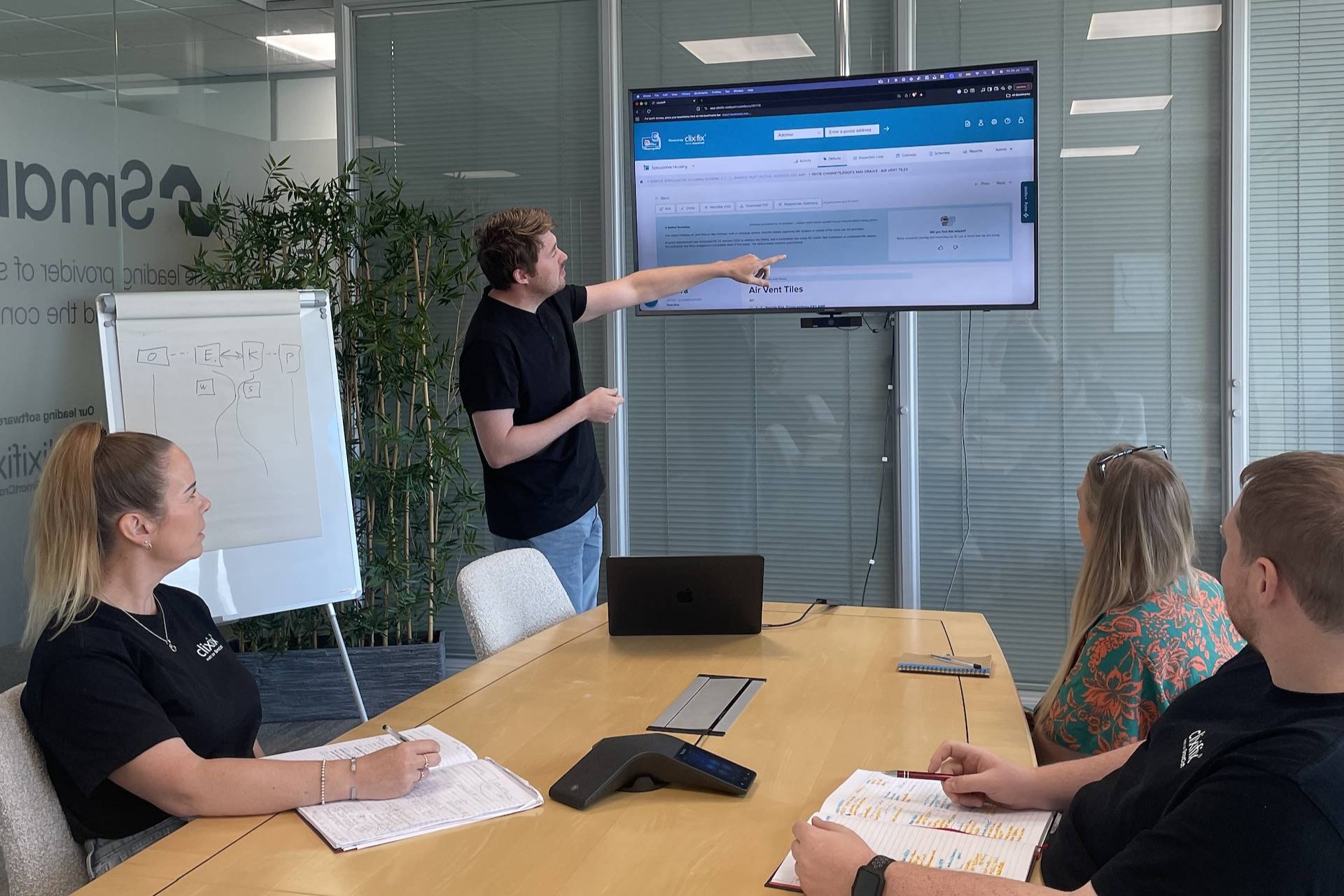
We’ve introduced an AI-powered summary tool that distils a long comment history into a clear, concise overview. It sounds modest. It is modest. But when a customer care manager is picking up a case, they haven’t looked at in a fortnight, or handing it over to a colleague, they no longer need to scroll through forty comments to understand where things stand. Multiply that across every item in a busy aftercare team’s queue, and you’re recovering hours every single week.
That is the kind of return we are interested in: not a flashy demonstration, but a quiet productivity gain that builds day after day.
“Can I just say how amazing the new AI Assistant feature is on clixifix® to generate summaries of tickets! You have no idea how useful this feature is to us, as previously we would have to scroll down the tickets, sometimes with over 100 comments on, to figure out what had happened. Thank you for making our life easier!”
Melanie Roberts, Customer Care Coordinator, Watkin Jones Group
Keeping Subcontractors in the Loop
Communication gaps between developers and subcontractors are one of the biggest friction points in defect resolution. A subcontractor misses an update, a follow-up falls through the cracks, and suddenly a straightforward repair has stalled for a week.
Smart follow-ups are one of the tools we are actively exploring. The idea is simple: automatically prompting subcontractors when communication goes quiet, recognising when a response is overdue and sending a reminder at the right moment to keep the resolution process moving, without somebody having to chase manually.
It’s not about replacing human judgement. It’s about making sure nothing slips through the net. For teams managing relationships with dozens of subcontractors across multiple developments, this kind of gentle automation could remove a significant administrative burden while improving outcomes for residents. We’re evaluating exactly how to get it right before we ship it.
“clixifix® has made a real difference to how we manage defects and customer issues. It’s intuitive, our teams find it easy to use, and it gives us clear visibility of what’s happening so we can keep on top of open tickets and hold our partners to account. The AI tools and ongoing product updates save us time, help us understand complex cases quickly, and ultimately mean residents are seeing issues resolved.”
Kerry Courts, City of York
Seeing What the Photo Shows
We are also applying AI to defect imagery. When a photo is uploaded against a defect, our image analysis tool can identify and categorise what appears in the picture, such as cracking, damp or incomplete finishes. This adds structured information to what would otherwise be a static image within a thread.
The result is faster triage, more consistent categorisation, and less time spent interpreting photos that were taken in poor lighting at 7am on a December site visit. It’s another example of a small, focused tool that quietly removes friction from a process teams repeat hundreds of times a month.
Evaluating With Purpose
We will not pretend that we have all the answers mapped out. Our product team has a long list of AI possibilities to explore, from predictive insights into recurring defect patterns to smarter triage of incoming reports. However, we are being deliberate about what we build and when.
Every feature we evaluate goes through the same filter:
Does it solve a real problem our users face today?
Will it genuinely save time, rather than simply looking impressive on a feature list?
Can we implement it in a way that is reliable and transparent, rather than creating a black box?
When the answer to all three questions is yes, it is worth pursuing. When it is not, the idea waits, no matter how exciting the technology behind it may be.
The Principle Behind the Product
AI is at its most useful when you barely notice it is there. A summary that appears when you need it. A follow-up sent before you remember to chase. An image that arrives with useful information already attached.
These may not be headline-grabbing features, but they are practical tools that allow aftercare teams to spend more time resolving defects and looking after residents.
That is the version of AI we believe in at clixifix®, and it is what we will continue working towards.
“Time is the thing you can’t create… if an AI tool helps you feel like you’ve got a team with three people rather than one, that’s massively helpful.”
Joanna Thomas, Customer Care Manager, 3West Developments